


The highest-impact tradie marketing ideas in Australia all follow one sequence: fix your Google Business Profile, get a website that converts on mobile, automate your reviews, respond to every lead within minutes, then add one paid channel. Do them in that order, not all at once. Foundations before ads, always. Give this 90 days of consistent focus and you’ll see measurable movement in leads and booked jobs.
TL;DR:
- Optimizing your Google Business Profile with real photos and accurate service areas can deliver quick, cost-free local SEO results within a few weeks.
- A fast, mobile-optimized website with dedicated suburb pages and simple contact forms is crucial for converting search traffic into leads and booked jobs.
- Automating review requests from satisfied customers and responding promptly helps boost local search rankings and build trust.
- Implementing missed-call SMS follow-up, webchat, and CRM contact sequences significantly increases lead conversion and response speed.
- Rented channels like paid ads and marketplaces should be carefully tested, capped at 20% of marketing spend, and only scaled after establishing a solid foundation.
Table of Contents
- 12 quick-win tradie marketing ideas you can start this week
- Google Business Profile: your primary free asset
- A website that converts: mobile speed and suburb pages
- Reviews and reputation: automate the request, not the answer
- Capture every lead: missed calls, webchat and simple forms
- CRM and follow-up: turn enquiries into booked jobs
- Advertise smart: Google Ads, Meta and marketplaces
- Owned versus rented channels: the 20% rule
- A 90-day priority plan for tradie marketing
- Handing it off: a checklist for briefing a contractor
- Why systems beat scattergun tactics for tradies
- Missed calls cost jobs. Here’s how Ask Hayley closes that gap
- Sources
12 quick-win tradie marketing ideas you can start this week
You don’t need a marketing degree or a big budget to move the needle. You need the right dozen things done properly, in the right order. Here’s a punch list ranked from lowest effort to highest impact, so you can knock over the easy ones today and save the bigger jobs for the weekend.
- Update your Google Business Profile photos and service areas. Fifteen minutes, no cost. Add real job photos and correct suburb coverage.
- Add click-to-call to your website. A developer can do this in an afternoon; it removes the friction between “interested” and “calling.”
- Set up missed-call text-back. One setup session, then it runs forever, catching every lead who hangs up rather than leaves a voicemail.
- Ask for reviews via SMS. Send the link the moment a job wraps up, while the customer is still standing there happy with the result.
- Build one suburb landing page. Pick your busiest service area first; this is a half-day job with outsized local SEO payoff.
- Publish three job photos a week. Phone camera is fine. Consistency beats production value here.
- Brief a one-page landing site for Google Ads. Needed before you spend a dollar on clicks, not after.
- Set up webchat on your site. Useful if you get evening browsers who won’t call but will type.
- Automate your review request. Trigger it from job completion in your CRM or field app, not from memory.
- Claim and verify every business listing. True Local, Yellow Pages, Hipages profiles all need the same details as your GBP.
- Run a small geo-targeted Facebook test. Best for visual trades like landscaping, tiling, or renovations; cap the budget and watch it for two weeks.
- Put signage on active job sites. A corflute sign at a driveway or worksite is still one of the cheapest local ads you’ll ever run.
Start at the top. Items one through five cost nothing but time and compound fastest.
Google Business Profile: your primary free asset
Your Google Business Profile (GBP) is the first thing a potential customer sees when they search “electrician near me” at 7pm on a Sunday, and most tradies treat it like a business card they filled in once and forgot. Treat it instead like a living asset that needs weekly attention.
- Complete every category field and list every service you actually offer, not just your trade name.
- Set accurate service areas rather than a single pin, so Google matches you to the right suburbs.
- Upload real photos: the van, the crew, before-and-after job shots. Stock photos hurt more than they help.
- Post weekly with job photos captioned with the suburb name, which helps Google’s local ranking signals connect you to that area.
- Reply to every review, good or bad, within a day or two.
- Use the Q&A section to pre-empt the questions you get on every quote call.
Run a small test: add one or two extra “service” photos a week for a month and track whether call volume shifts. Most guides for Australian tradies agree GBP and other owned assets deliver the highest return before you spend a cent on ads, and this is exactly why. It’s free, it’s yours, and Google rewards the tradies who bother to keep it current.
A website that converts: mobile speed and suburb pages
A slow website loses jobs before the customer even sees your pricing. If your site takes longer than three seconds to load on a mobile connection at a job site with two bars of reception, you’ve already lost that click. Local SEO and suburb-specific landing pages sit among the highest-priority channels for Australian tradies, and neither matters if the page underneath is slow or hard to use.
Here’s what a converting tradie website actually needs:
- Your phone number visible without scrolling, on every page, not buried in a “contact us” tab.
- A form with three fields maximum: name, phone, short job description. Anything longer and people abandon it.
- Dedicated service pages and suburb pages, each with a local example and structured data so Google understands what you do and where.
- Real project photos and a short testimonial snippet on every service page, not just a generic homepage gallery.
- A lightweight, dedicated landing page ready before you run any paid traffic, with one clear call to action.
If you’ve never worked out what a slow or missing site is actually costing you in lost jobs, it’s worth understanding the true cost of not having a website before you assume your current setup is “good enough.” Most tradies underestimate it badly.
Reviews and reputation: automate the request, not the answer
Review count and recency both feed local search ranking, and the tradies with a steady stream of fresh five-star reviews consistently outrank the ones with 40 reviews from three years ago. The fix isn’t complicated. Ask every single customer, every single time.
- Send a direct Google review link by SMS the moment the job is finished, while the ute is still in the driveway.
- Trigger the request automatically from your CRM or field app when a job status changes to “complete,” so it never relies on you remembering.
- Respond to every review professionally. For a good one, thank them by name and mention the suburb or job type. For a bad one, acknowledge the issue calmly and take the detail offline.
Pro Tip: Keep a saved SMS template ready to fire the second a job’s marked complete, timing beats wording every time. A review sent five minutes after the job finishes converts far better than one sent the next morning.
Review velocity and volume both support this: local SEO guides consistently point to review momentum as a trust and ranking driver, not just a nice-to-have.
Capture every lead: missed calls, webchat and simple forms
You’re up a ladder or under a sink when the phone rings. That call either goes to voicemail (where most people hang up) or it needs to be caught another way. Missed-call text-back solves this instantly: the moment you miss a call, an automatic SMS goes out along the lines of “Sorry we missed your call, we’re on a job right now, reply here with your job details and we’ll call you back within the hour.” That single message materially increases the chance of converting an inbound enquiry that would otherwise disappear.
- Set up missed-call text-back through your phone provider, CRM, or a purpose-built tool.
- Add webchat if you get evening or after-hours browsers who won’t ring but will type; skip it if your leads almost always come by phone.
- Keep every web form to name, phone, and a short job description, routed straight into your CRM.
Pro Tip: A missed call with no follow-up is a job gone to the next name on the search results page. Practitioners consistently flag response speed as the single biggest convertor in trade marketing, ahead of almost every paid tactic.
This is exactly the gap a voice-first tool like Ask Hayley is built to close, answering and pre-qualifying calls when your hands are full elsewhere.
CRM and follow-up: turn enquiries into booked jobs
A lead that isn’t followed up within the hour cools fast, and one that isn’t followed up within a day is usually gone. Your CRM doesn’t need to be complicated. It needs four things: lead capture, tagging, a simple quote pipeline, and automated SMS or email follow-ups.
- Send an immediate SMS the moment a lead comes in, confirming you’ve received it.
- Follow up again at 24 hours if there’s no response.
- Follow up a third time at 72 hours with a slightly different angle, maybe a photo of similar work.
- Send a final check-in at one week before moving the lead to “cold.”
Track your conversion rate by channel so you know which source of leads actually turns into booked jobs, not just enquiries. A simple flow, form fills into CRM, which triggers an SMS, which later triggers a review request once the job’s done, means the whole system connects instead of relying on you remembering every step.
Advertise smart: Google Ads, Meta and marketplaces
Paid advertising only works once the conversion foundation above is solid. Sending clicks to a slow website with no fast follow-up is money down the drain.
- Google Ads suits emergency and high-intent jobs: burst pipes, blocked drains, no power. People searching at 11pm want a call back now, and Google Ads catches that intent better than any other channel.
- Meta (Facebook and Instagram) suits planned, visual projects: kitchen renovations, landscaping, decking, anything with a strong before-and-after photo.
- Marketplaces like lead-generation platforms can fill gaps in quiet weeks but they’re a rented channel, competitive by nature, and worth testing carefully against your true cost per booked job.
Whichever channel you pick, geo-target tightly to your actual service area, send traffic to one dedicated converting page (not your homepage), and start with a small, capped budget. A practical guide to structuring Google Ads campaigns is worth reading before you set your first campaign live. Track calls and booked jobs from day one so you can calculate real cost per booked job, not just cost per click.
Owned versus rented channels: the 20% rule
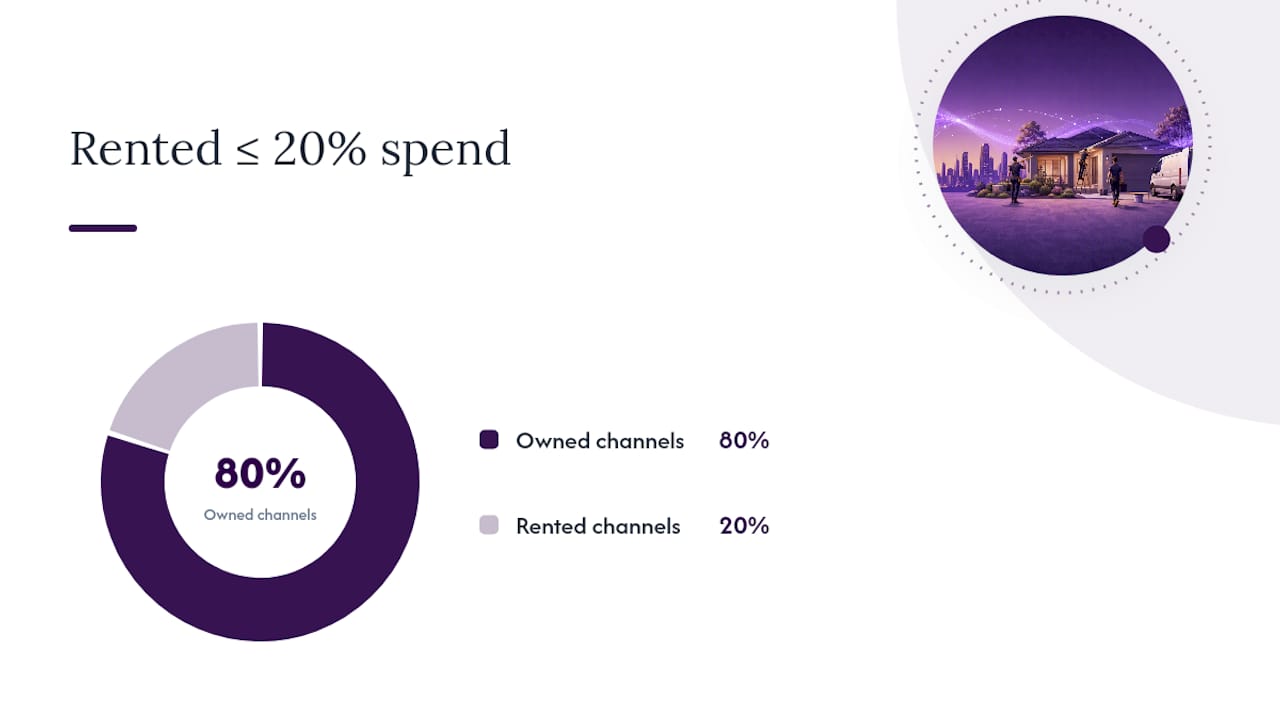
Your Google Business Profile, your website, and your review base are owned channels: you control them, and every dollar spent improving them keeps working for months or years. Marketplaces, lead platforms, and paid ads are rented channels: the moment you stop paying, the leads stop.
Cost per booked job is the number that matters, not cost per lead or cost per click. Add up everything: ad spend, platform subscriptions, and any per-lead fees, then divide by jobs actually booked, not just enquiries received.
- A practical rule some operators use is capping any single rented channel at roughly 20% of total marketing spend until it proves its cost per booked job over a full 90-day test.
- If a channel’s cost per booked job is still higher than your average job margin after 90 days, cut it and reallocate to an owned channel instead.
Say you spend $600 on Google Ads in a month and it produces four booked jobs. That’s $150 per booked job, a number you can only judge against your actual job margin, not against a competitor’s guess.
A 90-day priority plan for tradie marketing
Trying to do everything in week one is how most tradies burn out on marketing and give up. Spread it across three months instead.
- Month 1: foundations. Fix your Google Business Profile completely, patch the obvious website issues (load speed, phone visibility, a simple form), and set up missed-call text-back. Success looks like: GBP fully complete, site loads under three seconds, no missed call goes unanswered.
- Month 2: automation. Turn on review request automation, build your CRM follow-up sequence, and run one small paid ad test on a single geo-targeted, capped budget. Success looks like: review count climbing weekly, lead response time under an hour, one channel generating trackable data.
- Month 3: refine. Calculate cost per booked job across every channel, cut what’s underperforming, add a second suburb landing page, and layer in retargeting for warm traffic. Success looks like: a clear cost-per-booked-job figure for every channel and at least one confirmed winner to double down on.
This sequence mirrors the three-step approach most Australian tradie marketing guides land on: get found, capture the lead, follow up automatically. Skipping straight to paid ads without the first two steps is the most common reason tradies say marketing “doesn’t work.”
Handing it off: a checklist for briefing a contractor
Some of this you’ll do yourself on a Sunday night. Some is worth briefing to a web developer, a local SEO contractor, or an admin hire. Either way, set clear acceptance criteria before the work starts.
- GBP: every category filled, service areas accurate, five or more recent photos, no unanswered reviews older than 48 hours.
- Website: loads under three seconds on mobile, phone number visible above the fold on every page, suburb pages built to the same standard as your main service pages.
- Missed-call SMS: fires within 60 seconds, includes a callback promise and timeframe, sample: “Sorry we missed your call, we’re on-site right now, reply with your job details and we’ll ring back within the hour.”
- Review automation: SMS sent within 15 minutes of job completion, tested on at least five real jobs before rollout.
- Ads: landing page built, conversion tracking installed, and spend capped before the first campaign goes live.
Roles worth hiring or briefing: a web developer for the build, a local SEO contractor for the suburb pages, and an admin hand or automated system for the day-to-day follow-up.
Why systems beat scattergun tactics for tradies
Every tradie I’ve seen chase marketing “hacks” ends up with a scattered mess: a Facebook boost here, a flyer run there, a lead platform subscription nobody remembers signing up for. None of it connects, so none of it compounds.
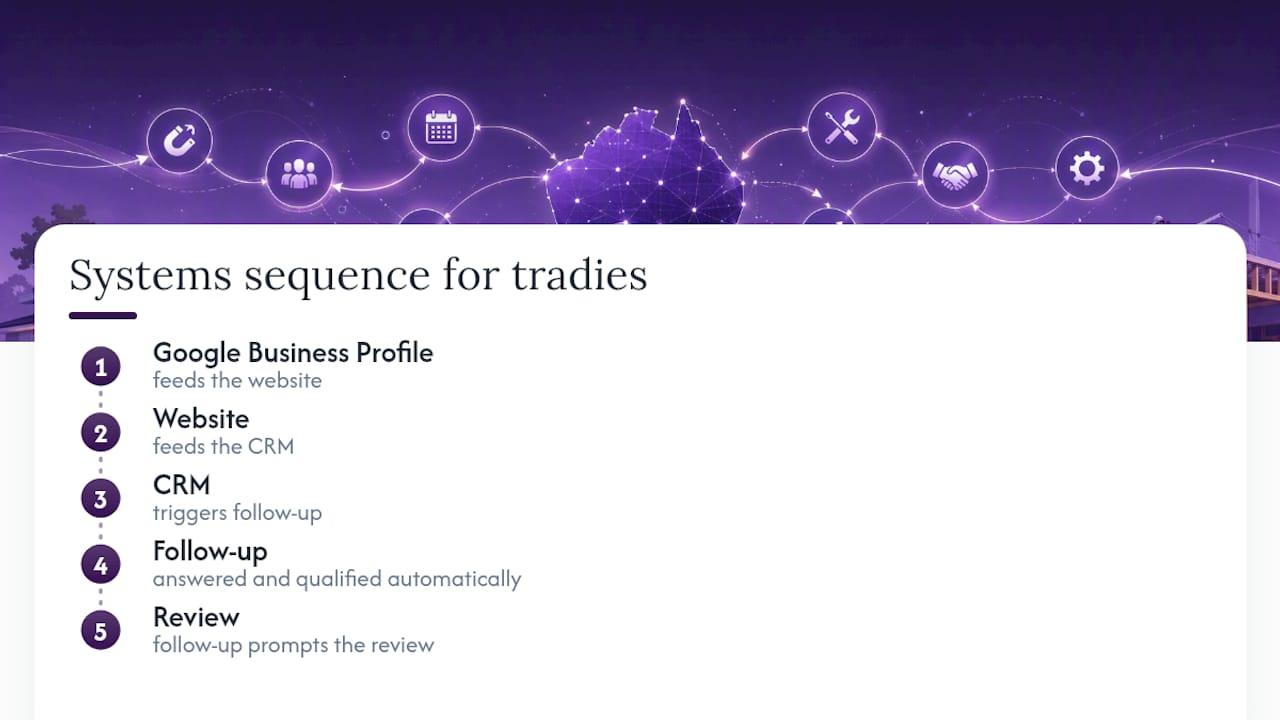
The tradies who actually grow treat marketing as a system: Google Business Profile feeds the website, the website feeds the CRM, the CRM triggers the follow-up, and the follow-up triggers the review. Each piece makes the next piece work harder. That’s the entire argument behind sequencing foundations before ads. Ads poured into a broken system just get expensive, fast.
Voice-first tools matter here because the weak link for most tradies isn’t strategy, it’s execution while your hands are full of tools. A missed call at 2pm on a job site is a lost job, not a marketing problem you’ll fix later. Systems that answer, qualify, and log a lead automatically remove that failure point entirely, which is worth more than any clever ad campaign.
If you want to go deeper on measuring what’s actually working, our field service KPI guide is a good next stop.
— Hayley
Missed calls cost jobs. Here’s how Ask Hayley closes that gap
Every tactic in this guide falls over at the same point: the phone rings while you’re up a ladder, and nobody answers it. Ask Hayley is built specifically for that moment. It answers inbound calls when you can’t, asks the right questions to pre-qualify the job before it lands in your inbox, and logs the details automatically instead of relying on a scrawled note on the dash of your ute.
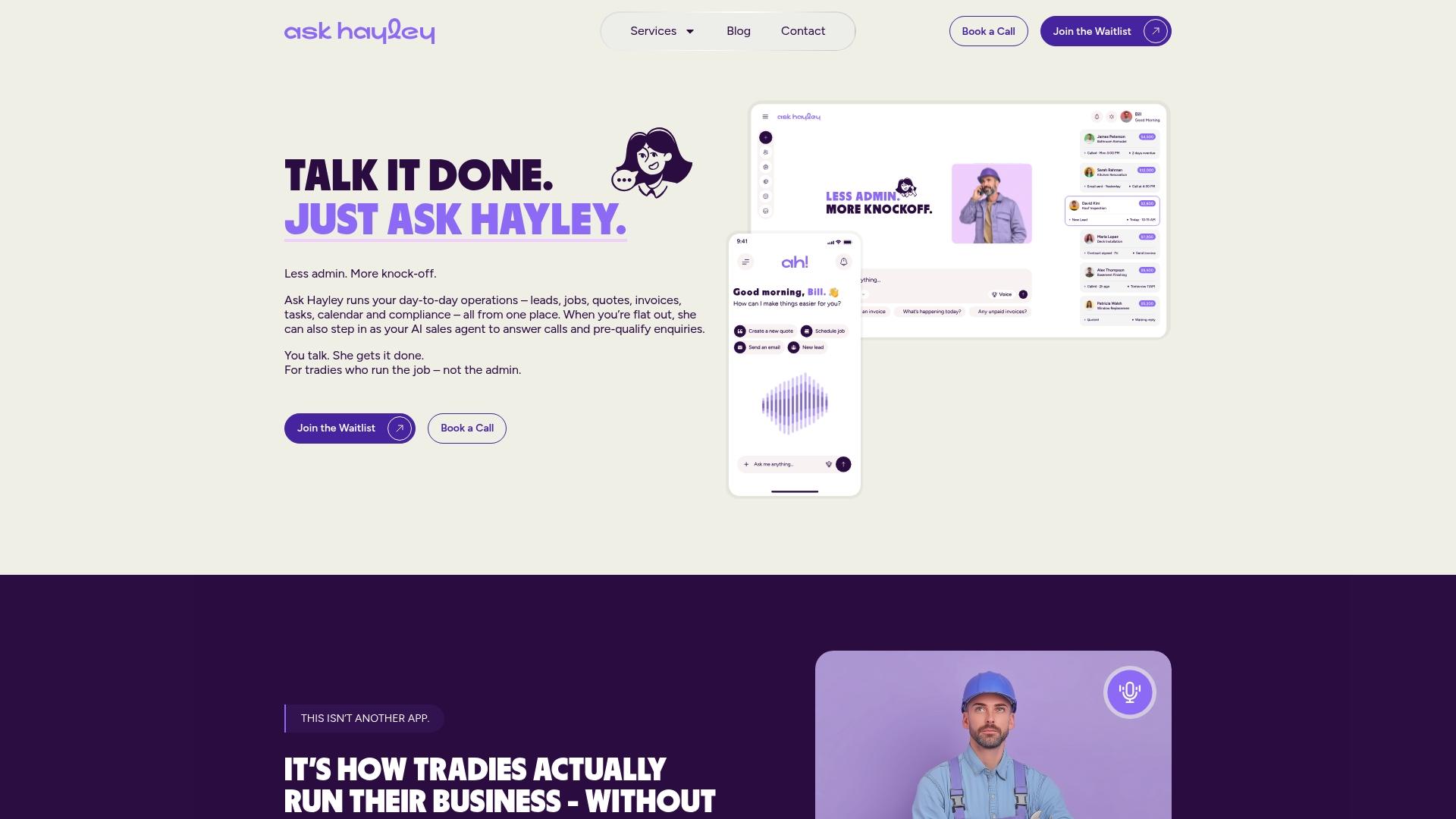
That covers three of the biggest leaks in this article directly: missed calls, slow follow-up, and the admin drag of chasing review requests by hand. Rather than adding another app to check between jobs, you talk to Hayley the same way you’d brief an office manager, no forms, no dashboards, just a normal conversation. Plans cover call handling and admin with different levels of support, with optional add-ons like an AI Sales Agent for businesses fielding higher lead volume.
If missed calls or slow follow-up are costing you jobs right now, the practical next step is to book a demo of Ask Hayley’s services and see how it slots into the way you already work.


